STAY CURRENT WITH THE WITCHING WORLD

Saturday, April 28, 2012

*** GIVEAWAY ***

It's the very 1st Pagan Presence GIVEAWAY!!!! 
Woo hoo: freebies!!! 

For many months I have been diligently working to perfect a line of sugar foot scrubs and am inexpressibly excited to have the first three recipes ready for shipment!!!

These scrubs feature Turbinado Sugar [Sugar in the Raw], Grapeseed & Almond oils blended with the essences of Orange, Lavender, Grapefruit, Spearmint and more.  Your feet will thank you for such an indulgence!

And what better than to share these amazing scrubs with a fabulous reader!


RULES OF ENTRY
____________________________________________

1.  Visit Essential Presence on Facebook and "LIKE" the page.
2.  Return to Pagan Presence on blogspot and comment with "TREAT MY FEET"

That's ALL?  Yep!  That's ALL!!!  The giveaway will end at sunset on May 4th 2012
at which time I will gather the names of the participants
and pull a winner from my [pointy] hat!

I will contact the winner by midnight on the 4th to share the good news
and obtain shipping details.

Good luck my wicked friends!!
____________________________________________


The three sugar scrubs are also available for purchase on my Etsy shop, ESSENTIAL PRESENCE.
Keep checking back to Etsy and our Facebook page for new scrubs and other organic products [such as the Sweet Orange & Thyme All-Purpose Cleaner].  Gift baskets also coming soon!!

a.  Sweet Orange Sugar Scrub
b.  Lavender Orange Sugar Scrub
c.  Citrus Mint Sugar Scrub

Treat your Feet... it's ESSENTIAL!

Monday, April 23, 2012

Coming Out of the Broom Closet

"Coming out of the Broom Closet"

It's a phrase that cycles often through the Pagan community.  And as silly as it may sound to some, there are those who find the idea of publicly announcing a connection to this still very misrepresented faith a bit overwhelming.  Not silly, but scary!

Not everyone can afford to be linked to something that takes them "off the beaten path" in the eyes of their peers.  Forget any hope of being seen as a cutting-edge, unique individual that might offer a refreshing perspective.  No, you'll become "the odd man out", "that devil worshiper", "the freak".  Or at least that's what many closeted Pagans fear may be the reaction they will face if they ever chose to "come out".

Everyone's situation differs and it may be that you whole-heartedly fear a loss of your job, family or friends should you let your faith be known.  No judgments from me!  But in my heart I can't see a healthy benefit in masking who it is you truly are within.

In honor of the upcoming International Pagan Coming Out Day [May 2nd], I wanted to take the opportunity to share my own story of finding this well-worn path that many of us call home.

"So, when did you discover that you were a witch?"

I recently finished reading "The Goddess is in the Details" by Deborah Blake, author and High Priestess of the Blue Moon Circle.  In her first chapter she tells very enchantingly of the moment she felt "an indefinable something inside [me] shift and change".  She speaks of one Halloween when she was persuaded to come to a Pagan event hosted by her friend.  Reluctantly she decided to attend.

          Deborah writes, "And there, amid the trees, in a clearing lit only by moonlight and candle flame, something unexpected happened.  The circle was cast, the quarters called, the gods invoked, and I felt an indefinable something inside me shift and change."

          She was amazed to find a profound connection to Nature and to the other members of the party, who had, but moments ago, been merely strangers.  Deborah felt as though she had touched the gods and that they had touched her back [chapter 1: page 8].

          She proclaims, "never had I felt with any certainty that there was, in fact, a god.  But on that Samhain night, in that circle in the park, I was suddenly absolutely sure:  sure that there was deity around me and inside me, sure that what I had found was the right path for me.  I was a Witch, and I had come home."

Many  a-story of finding the Pagan faith[s] elude to this idea of "coming home" -- like it was always waiting quietly in the shadows of your life until that moment when you finally noticed it and it pulled you with warm welcome into its arms.  I know the feeling well...

I was raised Roman Catholic -- just about as anti-Witch as you can get!  And I didn't really think about it much until... well, until reaching an age when I actually started to think about it!

My mother would dress us up and haul us off to church on Sunday mornings, which, aside from being exceedingly boring, didn't cause me much concern.  That is, until my growing little mind began to sort through what it was that they were preaching -- there were stories with lessons and rules [oh!  The rules!].  And when I began attempting to make sense of it all, well, there were just too many conflicting details.

And so... what was a confused and curious young girl to do but to ask for clarification [because, after all, the only 'dumb question' is the one not asked, right?].   Not quite.

I was probably age seven or eight when I began Religion Classes.  This was my opportunity to make some sense of it all -- or so I thought.
           
          "Are they sure Jesus was born in December?  Because that's when we celebrate Christmas but The Bible says there were shepherds living in fields nearby and watching over their flocks and I don't think that happens in winter."  

          "What do Easter eggs and bunnies have to do with our Lord?"  

          "You said Jesus was crucified on Friday and rose on Sunday but that's really not three days like they say in church ['on the third day he rose again in fulfillment of the scriptures' -- yes it's still burned into my brain]."

This innocent mind wanted to know!  And I was ready for their answers [so that I might set some order to the madness I was hearing].  But these answers never came.  Instead I was warned about doubting the word of God.  "Just have faith" I was told. 

Have faith?  Have faith that the Lord thinks Friday afternoon to Sunday morning could somehow work out to be three days?  I can't imagine the look that must have fastened itself onto my perplexed little face but regardless, that was the end of that!  No room for discussion!

It wasn't but a year or two after this that I learned of a particularly well-like Father's involvement in an embezzlement scam.  That was my breaking point.  I had suppressed my desire to clarify some fairly senseless Christian claims and did my best to "just have faith" when all the while these very people [who stood preaching about righteousness endless Sunday after endless Sunday] were picking the pockets of those who turned to them for spiritual purpose.

I likely couldn't have defined the term "double-standard" back in those days but I sure as heck could tell you how it made a person feel!  Abandoned.  Lost.  Dare I say... bitch-slapped?!  I dare!!!

My mother never batted a single eyelash when I told her I would no longer be attending church.  I think she herself questioned what benefit the Catholic faith could bring to her children.  Truly I believe that the only reason she ever dragged us there to begin with was a thoughtless fall into the family routine she herself was raised to follow.  It's just what you did.

I was quite content without religion... for awhile.  It was about my junior year of high school that I noticed a soft-spoken emptiness inside and began to explore.  I attended a church function with a friend who was Born Again and was frightened away from that very restrictive belief system just about as fast as my cut-off shorts would take me!

It was random chance that would lead me to the "Pocket Guide to Wicca".  Random chance.  Or was it?  Perhaps I was supposed to be in that bookstore at just that moment, walking around aimlessly after picking up a new hard-cover blank journal [to house my totally deep, teenage-drama poetry].

Property of Looney Toons
So we've all learned that the Catholic religion had left me with a bitter taste towards spirituality.  And I'm not ashamed to admit that when I first came across the small section of books on Witchcraft, my initial draw to it came from a deep desire to stick it to those Roman Catholic hypocrites!  What could be worse than turning to the very heathens that they'd preached against?!   * insert sinister cackle like the one by the plump witch from Looney Toons *

This less-than-virtuous motive was enough to get me to purchase that  pocket guide.  Little did I know how much it would change my life.

The mini book laid out the basic foundations of Wicca with simple descriptions of rites, elements, correspondences, sabbats and more.  The text itself contained no rushing waves of passion and power.  And yet, through its simplistic breakdown of the Faith it was very clear to me that this was a belief system that encouraged a more personal connection to divinity.  It wasn't about doing what everyone else told you to do so that you might 'find the Lord'.  It was about doing what felt right so that you might develop a personal inner relationship with deity.

And when it related across the board to the profound expressions of Ralph Waldo Emerson that I so cherished -- those expressions that stated God's ability to connect with every individual through private door to their heart -- that is when I felt "the shift".

At age 16 I had found what was needed to occupy the void that Catholicism had left within me.  And it truly was a "coming home".  It was comfortable and uplifting.  The world was brighter, the wind was crisper.  After years of reading, learning and following a more typical Wiccan path, I veered onto my own trail of eclectic Pagan beliefs and inspirations.

And today I don't turn to anyone to validate my connection to divinity.  Just as author Deborah Blake expressed in her book, I too touch the gods and they touch me.  And while I've faced judgments and opinions from others as I've walked this ["off-the-beaten"] path, I need only look within to recognize that what they think they know dulls in comparison to what I feel is right [for me]. 

My Pagan faith fulfills me.  It gives me the foundation to face a hectic and imperfect world with optimism and with confidence.  It provides me with a compassion for others -- something that I noticed [even as a young child] is very lacking in the Catholic community [generally speaking, of course].  I live with an outlook of "open-mind & open-heart".  Everyone matters because everyone is connected at a level deeper than what this physical world allows us to recognize. 

And to now see my two sons growing up to cherish and accept everyone as special and unique -- to know that they themselves hold a special light which makes them a 'one and only' -- that has served to enhance the gratitude I have for my faith.

A friend [one raised to fear and detest Pagan religious beliefs] once told me that I should at least take my children to a non-denominational church so that they are raised with some sort of foundation.  Rather than take offense, I almost laughed, with all sincerity, right in her face!  My children have more compassion and genuine respect for themselves and others than your average, educated adult!  They do not lack anything that a Christian counterpart can claim.  And in fact, I find that because they are not taught that one path is the only path, my children are more likely to form a lasting bond of genuine acceptance with another person than might a child from a monotheistic faith.

Yes I'm 100% out of the broom closet!  Plenty of storage space in there!  I don't worry about the opinions that others form based on misconceptions that continue to circulate... because I live by example.  Someone can examine my life, my words and my actions and know that it is my belief system that grants me the open-hearted perspective that I have towards the world around me.

In the Closet or Out, Bless-ed Be my Pagan friends.  Know that you are beautiful.
Love & Light,
Em


Wednesday, April 18, 2012

Snake Handlers

I am thoroughly fascinated by all things 'religion' -- the history, unfolding and overlapping of it all!  So when I get ambitious I take on the challenge of theology-related open courseware available [for free!] via elite schools such as Notre Dame and Yale.  Ever try them out?  They're wonderful!  Entire semesters of courses in a variety of topics provided to the general public free of charge -- all for the noble purpose of extending knowledge to the masses.

My latest endeavor is a course provided by MIT titled "Magic, Witchcraft and The Spirit World".  Right up my alley, right?!  And yet who might've thought that with such a title we would be diving head-first into the curious world of Pentacostal Snake Handlers?!

My initial reaction: What does a sect of Christian outliers have to do with magic, Witchcraft or the Spirit World?

In the name of knowledge however, I quieted my objections and was rewarded with a frightening journey into the overzealous minds of "The Holy Ghost People".  I provide my written assignment on the subject below.

Pentacostal Snake Handlers
Photo by Melissa Singer
Magic, Witchcraft & The Spirit World
Professor James Howe
MIT


April 18 2012


The Book of Mark [16:17] preaches
“these signs will accompany those who have believed: in My name they will cast out demons, they will speak with new tongues; they will pick up serpents, and if they drink any deadly poison, it will not hurt them; they will lay hands on the sick, and they will recover.”

Is this small portion of the Holy Bible, translated by a small church in Scrabble Creek West Virginia as the literal word of God, sole inspiration for the mumbling, twitching, hollering, dancing, convulsing, poison consumption and dangerous snake-handling undertaken by its members? 

One outsider, journalist Dennis Covington, began as neutral observer and soon found a permeating power in the depth and atypical display of the group’s belief.

Each member of the rural congregation claims with grand passion to have received the Holy Ghost, finding proof of this in the signs offered to them by the aforementioned verse in the book of Mark.

Their excitement for this extraordinary connection to the Divine is expressed with an almost orgasmic melodrama -- flailing themselves about in such jerking spasms and reckless imbalance that, if encountered in society outside of this religious sect, would incite a reaction of urgent alarm and an immediate call for emergency services.

As one leading member of the informal church service mentions, the Bible preaches “against idols, I-D-O-L-S, and it preaches against idles, I-D-L-E-S”.  It is because of this latter testimonial that the members of this church strive to express their faith with such an overactive participation. 

They welcome the Holy Ghost as it enters them and takes control of their bodies.  Through this assumed union of soul and God they work as faith healers to any who claim an ailment and dance in chaotic, uncoordinated groups all while carrying poisonous snakes, such as Copperheads and Rattlers -- even tossing the serpents to one another across a crowded room filled with babies and children. 

It is unclear through the mumbling of their ‘new tongue’ or the few bits of Gospel shared in the stumbling voices of clearly uneducated adults what purpose these snakes serve and why the risk of a bite is worth their continued use in church services.  

In the Hebrew Bible, the Book of Genesis refers to a serpent that was responsible for the fall of man [2Cr 11:3].  Do the members of this and similar congregations view their snake-handling as a sort of conquering of temptation and of evil by the pure goodness of their received Holy Ghost? 

If this is so, their reactions upon seeing a fellow member bitten by one of the potentially deadly snakes portrayed a very tangible doubt in their divine invincibility.  In spite of any fear that may have provided them a moment of clarity and humility, the group refrained from seeking medical attention for their stricken brethren and instead turned back inward to the Holy Ghost that they believed waited within to ensure a miraculous healing. 

And should they fail; should he die, would they come to realize the irrationality of their practices?  Not likely.  The congregation had seen the loss of members due to snake bites in the past.  Most felt that a failed faith healing resulted when those among them did not fully believe.

These impassioned church-goers may or may not truly experience being taken over by “Holy Ghost” but they believe in the signs listed by the Book of Mark and accept these as proof of their ethereal enlightenment.  And this belief has power.

When journalist Dennis Covington describes the first time he takes up a serpent, this once objective bystander claims to lose himself in light, stating “There is a power in the act of disappearing; there is a victory in the loss of self.”

There is no doubt as to the dangers faced by members of this Scrabble Creek church but perhaps an outsider will never fully understand what it means to be guided by something larger than one’s self when you take up a serpent in the name of the Lord.

Tuesday, April 17, 2012

In Search of History : Salem Witch Trials

IN SEARCH OF HISTORY : SALEM WITCH TRIALS by The History Channel

Today's post provides Part One of a three-part offering of the Manuscript for The History Channel's special on The Salem Witch Trials.

Manuscript by Em Graves

In 1692 mass hysteria and rampant paranoia swept the New England countryside.  Citizens in the small village of Salem were being accused of casting spells, of consorting with the devil, of being witches.  This persecution was a relatively new phenomenon in America, but across France, Italy, Germany and England massive witch hunts had been going on for 300 years.

From the 14th to the 16th centuries an estimate forty to fifty thousand people were executed.  The religious impetus for this human devastation came from the holy scriptures. 

DAVID GOSS      [former] Executive Director, Beverly Historical Society

“What is written in the bible is the word of God.  It is viable.  It is   infallible.  And we have to live by it on a daily basis.  And when you read, in the Book of Exodus Chapter 22 Verse 18: Thou shalt not suffer a witch to live.  There it is.”

Despite the biblical condemnation, early Christians were relatively tolerant of Paganism and witchcraft.  But as the Roman Catholic Church began to consolidate its power, heretics were looked on as enemies.  By 1231 Pope Gregory IX instituted the Inquisition in order to expose and punish heresy.  From this point on attitudes toward witchcraft took a decidedly violent turn.

 In 1484 Pope Innocent VIII declared witchcraft a heresy.  The punishment was death.  Witch hunts were often conducted by superstitious villagers.  As animosities and tensions rose amongst them, the villagers used the witch hunt as a convenient and powerful tool to get rid of their imagined or real enemies.  And the authorities did very little to stop them. 

RONALD HUTTON            Professor of History, University of Bristol

“Let’s make a play on what a witch hunt actually means.  It doesn’t mean that people with hoods go around knocking on doors and asking if any witch is there.  It means that unusually the authority is actually encouraged local people to be afraid of each other and to denounce each other as witches.   It’s both a purging of the local community by itself and a hysteria whipped up by people who ought to have known better -- people in charge.”

Once a person was accused of being a witch, it was still necessary to provide concrete evidence before prosecution.  But how do you prove that a spell or curse has been cast?  What the authorities needed were other, more tangible signs, of witchcraft. 

In 1486 a guidebook on finding witches called MALLEUS MALEFICARUM, or The Hammer of the Witches, was published.  It provided a definition of witchcraft as well as rules on how to investigate, try and judge cases.  The book stated that one sure sign of a witch was the Devil’s Mark or Witch’s Teats.  Looking for the Devil’s Mark became a very popular pastime and may have served more prurient interests than the health and welfare of the community.  It involved a careful inspection of the suspected witch’s body, which could only be accomplished after shaving all of his or her hair, including the genital area.

RONALD HUTTON            Professor of History, University of Bristol

“It’s an old folk tradition based on the idea that the Devil, making a pact with the witch, leaves a special mark which is in turn based on an even older tradition that witches have teats through which they suckle their familiar spirits -- the animal spirits that serve them.  The idea is that if you can find these marks, these teats, you can prove that this person’s a witch.”

DAVID GOSS      [former] Executive Director, Beverly Historical Society 

“They would then test that mark by piercing it with a needle or pin.  If pain was felt or if blood was drawn from the mark, there was no evidence there to indicate that this person was a witch.  On the other hand, if after probing with a needle or pin, they find there is no pain and there is no blood, it is not normal.  It is not natural.  It is unnatural.  Then there is evidence, in their view, that this might in fact be a witch’s mark.”

Another popular method in the Middle Ages was called “Swimming a Witch”.  The theory was that water, being pure, would reject all evil.  The belief was that a witch would float and an innocent person would sink.  The test always provided a victim.  The Malias Maleficarum also encourage torture as a way to illicit a confession from a suspected witch.  

RONALD HUTTON            Professor of History, University of Bristol

“The best way of obtaining a confession is to apply force.  That’s in purely brutal, practical terms.  The most effective actual method used was known as ‘the stripadum’ and was just like having your arm twisted around your back, as in the school playground, except that it goes on for hours.  Now the reason why this was used is that it was excruciatingly painful.  It was horrible.“

Torturing suspected witches was justified in the eyes of the law.  English Magistrates considered the practice of witchcraft a crime against the Church and the State.

DAVID GOSS      [former] Executive Director, Beverly Historical Society 

“From the days of Henry the VIII and onward, the King is the head of the Church.  So your political leader is also the head of the Church of England.  And for this reason, when you turn your back upon God and upon the Church, you are also very much so turning your back upon your King.”

 Witchcraft was therefore considered an act of treason and a capital offense. Witch hunts continued unabated through the 17th century.  Neighbors accused neighbors.  Thousands of innocent lives were lost. 

In 1629 King Charles I of England granted a religious splinter group called the Puritans -- a charter to settle and govern an English colony in the Massachusetts Bay.  Their desire?  To create a new, perfect society based on the principles of the Bible; a theocracy with no separation of Church and State.

CAROL KARLSEN               Visiting Professor, Harvard Divinity School & Professor Emerita, University of Michigan

“Their goal was a kind of model community -- what they called “a city on a hill” -- that would be a kind of light to people all over the world.  We still have that notion of the U.S. with us today but it was very intense in those early years.”


Not everyone who crossed over was a Puritan. 

JANE KAMENSKY             Professor of History, Brandeis University

“Others leave because they have no land, because they have no jobs; because their lives in England are so difficult that going to the edge of an unknown world and building a society out of nothing sounds better.  One of the things that eventually produces a natural kind of tension in many New England communities, as indeed in many Colonial communities, is you have people there for many different reasons."  


***Look for the upcoming Part 2 Manuscript for The Search for History: Salem Witch Trials on this blog in April 2012! 

Friday, April 13, 2012

Why Formal Religion Continues to Get It Wrong

What is the purpose of religion? 

This is a question that could be answered in as many ways and with as many voices as there are uncountable stars in the night skies.  And these various answers have often been the cause of the most heated controversial disagreements in the history of humankind.  It pins Catholic against Christian, Christian against Muslim, Muslim against Jew, Jew against Buddhist, Buddhist against Born Again, Born Again against Pagan.

But WHY?  For what reasons would someone care so deeply how another connects to divinity?

My opinion in response to that very question is simple -- POWER.

Share with another the very core of their beliefs beyond this physical world and you may but enslave them to join you against another of your peers who believes differently.  Grow your collection of these like-minded individuals and you might rule over their world. 

Sounds tyrannical for a reason -- it IS!  And the leaders of empires [if you journey back to consider days before the rise of Christianity] recognized the power in "sharing" the faith of its populations.  Why else might a ruling party get involved in what should be a personal connection between God and Self?  They were power-hungry then and it continues to this day.

So what was it that jump-started this world's longest-running power trip?  And how exactly did they do it so successfully?

Enter...

PHILO JUDAEUS          [25BC - 47AD]

Philo was a Greek-speaking Jewish writer who was "born before the beginning of the Christian era, and lived until long after the reputed death of Christ. He wrote an account of the Jews covering the entire time that Christ is said to have existed on earth. 

Philo was living in or near Jerusalem when Christ's miraculous birth and the Herodian massacre occurred. He was there when Christ made his triumphant entry into Jerusalem. He was there when the crucifixion [with its attendant earthquake, supernatural darkness, and resurrection of the dead] took place -- when Christ himself rose from the dead, and in the presence of many witnesses ascended into heaven.  These marvelous events which must have filled the world with amazement, had they really occurred, were unknown to him [Philo]." [The Christ by John E. Remsburg]

Why is it that Philo [who would have been a contemporary of Jesus Christ] [and who wrote extensively on the Jewish religion and area politics] documented not even a footnote on this supposed savior who was said to have been gathering a following and performing miracles along the Levant at this time?  And if the astounding birth and rise of Christianity's poster child is not historically factual, why was it crafted?  

Or was it?

Insert...

MITHRAS

Mithras, an Indo-Iranian deity of ancient Persia [linked to Zoroastrian beliefs and the later cult of Mithraism that ran through the soldiers of the Greco-Roman empire], predates Jesus Christ by more than a thousand years -- with first written accounts of him being mentioned in a Peace Treaty [circa 1400BC] between the Hittites and the Hurrian Kingdom.  [Journal of the American Oriental Society, 80.4, pages 301 - 317]  

Mithras was said to have been born of a virgin on December 25th, in a cave, attended by shepherds.  He was considered a great traveling teacher and master.  Mithras had 12 disciples, promised his followers immortality, was claimed to have performed miracles, and sacrificed himself for world peace.  Mithras was buried in a tomb and rose again [you guessed it] after three days.  Mithras was identified with both the Lamb and Lion and was called "the Good Shephard", "the Way the Truth and the Light", "Logos" [the Word], "Redeemer", "Savior" and "Messiah".   [The Mithras Liturgy, Marvin Meyer]  Oh, and the day set aside for worship of this "unconquerable Sun" God?  Yep, Sunday.  [RestoringOurJewishRoots.blogspot.com]

Sound familiar?  And let me restate that the deity Mithras of Persian mythology antedates Jesus Christ by over a thousand years.

So why then did the heads of the Roman and Byzantine Empires push so hard to spread what is likely an imitated story from another ancient belief system?  And why adopt the customs and rituals of even more faiths only to turn around and demonize those very religions?

POWER.

"Constantine's Conversion" by Peter Paul Rubens
Early Christianity was but one of many religions existing in the Roman Empire.  Constantine [the Great] would be influential in sparking the spread of this, his chosen religion.  So what did he see in this little known belief system?  Constantine realized that initial persecutions had failed against the Christians. Instead it only resulted in disharmony, which he disliked immensely. [Neobyzantine.com]

Through the Church, Constantine controlled the Christians in his empire. " The bishops now found themselves serving as Constantine's principal advisors and following his will. Many bishops actually owed their positions to Constantine. In return, Constantine gave them religious and judicial powers."  [Neobyzantine.com]

It's also curious to note which Pagan God was most supreme in Constantine's eyes -- Mithras.  Say what?!  Yes, there are very simple explanations for why this Christ and this Mithras seemingly share the same life.  Early Christians made it so.  [RestoringOurJewishRoots.blogspot.com]

The Council of Nicaea, [a council of Christian Bishops convened 325 years after the claimed birth of Jesus Christ by the request of Roman Emperor Constantine I], met to "create" statements and doctrines with the intent being to unify the beliefs of those followers of Christianity. Constantine adjusted the laws of the empire to reflect his Christian values.

From here Christianity spreads with the Roman Empire, and then the Byzantine after that -- at times quietly absorbing the customs and rituals of other belief systems; occasionally forcing conversion through the persecution, torture and death of those that would not repent.

And with this the power of the Church grew immensely.  Take one look at the authority and richness that is Vatican City.  A wealth beyond measure in antiquities [and all the corrupt secrecy one could imagine from a lifetime of lies and cover-ups].  

FAST FORWARD...

...to the United States today.  

Santorum & Romney
It's difficult not to see the relevance that religion plays in the American political arena.  Entire campaigns seem devoted to who is the better Christian.  And why?  What should it matter to me how you connect to divinity just as long as you know how to balance the nation's budget, manage our foreign policy with tact and keep employment and education numbers on the rise!  

It might be easier to swallow if in their hearts they truly connected with the values of this Christian Faith that they parade through the campaign trail, but considering the mockery they make of their personal faith during these media storms, I have my doubts about their sincerity.

When ulterior motives creep their way into a faith it becomes less about personal connections and more about personal agendas.  And this is why formal religions continue to get it wrong.  

Ralph Waldo Emerson declared that God has "unrestricted access to every soul, and conversely every soul has like access to all divinity."  One's spiritual connection should be through Self and not through the fattened pockets of pastor, priest or parish.


Wednesday, March 28, 2012

Now Whose Holy Day is an Oxymoron

In the wake of our beloved Mrs. B facing "religion-gate" [between her daughter and a particularly rude music teacher], let us all share a light chuckle over an insatiable irony -- the origins of Christianity's "Easter".  To fully appreciate the aforementioned irony it is necessary to know that this heinous educator proclaimed to Mrs. B's daughter...

"Pagan Holy Days are an oxymoron."

I know, right!  Now, pick up your jaws and let's carry on.

Because the truth of the matter is, their Easter, as celebrated across the globe today, and most especially here in the United States, is undoubtedly linked to a Pagan past.  One needn't strain to see the similarities between the Pagan celebration of Ostara [rooted in preChristian festivals honoring Spring, fertility and new life on earth] and the Christian customs of Easter [honoring the resurrection and "new life" of the Savior].

The name alone has been factually linked [World Book Encylopedia, (article, "Easter," vol. 6, p. 25)]  to "Eostre, a Teutonic goddess of spring, or from the Teutonic festival of spring called Eostur".  Eostre [Eostur/Eastur/Ostara/Ostar] was coined by the Norsemen to mean the birth of a new season and this name is given to the Anglo-Saxton Goddess of Spring and Fertility.  Considering the age of these cultures and their related words, celebrations involving such "Feasts of New Life" predate not only the Christian faith but the very birth of the Messiah.

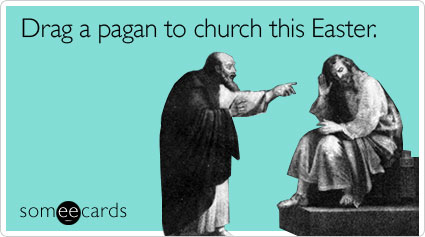
Is there even such thing as a double-oxymoron?!  Because if you follow the customs of a religious holiday that date back to Pagan origins which you then claim to be of themselves an oxymoron, doesn't that make your celebration of Easter a double-oxymoron?  Yikes, my brain hurts!

Another double-oxymoron courtesy of someecards.com
Please remember before belittling the beliefs of another that no Faith is without its controversy.  You have no more right to claim your holy days than I do mine.  Even your own holy book refers you to the Church-sanctioned holidays that you should be celebrating -- oh, and heads up... Easter is not one of them.  Nor Christmas.  

According to David C. Pack, [author of "God's Holy Days or Pagan Holidays"]: "The Bible does, in fact, mention Christmas and Easter—and certain other familiar holidays—but it bluntly condemns them as heathen customs. The proof is overwhelming that these days are “traditions” and “commandments of men.” But vast multitudes keep them anyway, seemingly content to worship Christ in vain!"

Even your own Jesus Christ is quoted to have said: “In vain do they worship Me, teaching for doctrines the commandments of men…full well you reject the commandment of God, that you may keep your own tradition” [Mark 7:7 9].  

So until you're willing to give up these highly-celebrated "holy" days, I suggest you bite your tongue when it comes to the traditions of others.  Shame on you for that alone and shame on you additionally for defiling your position as educator by demeaning the values of someone who once looked to you with respect.  Bravo for showing this impressionable young mind how very ugly the world can on occasion be.

Want to be such a snooty-puss?  Fine -- give us back our Easter Eggs, Easter Bunny, Easter Parade and Hot Crossed Buns!!  Oh, did you think they were your traditions?  Not quite.  I feel and sound very catty in stating that.  Normally I do strive to remain very tolerant of others.  After all -- how might we expect to receive acceptance if we can't offer it in return.  I guess when an individual is willing to attack the beliefs of a child however, my naughty kitty comes out to play.  [I just might have to get her declawed because if anything similar ever happens to my children, I'll probably swipe first and hiss later!] 

I leave you now with the following, a relevant excerpt from the Hope of Israel site:

What about the myriad customs that surround this day -- the chocolate bunnies, the Easter eggs, the parades? 

You may be surprised to learn that red, blue, yellow or green eggs, as symbols of the renewal of life, were part of a custom that goes back centuries before the birth of the Messiah. Eggs, a symbol of fertility in many lands, are easily traceable to ancient pagan lore. So is the famous Easter bunny. (Only the chocolate rabbit is modern.) This rapidly breeding and multiplying animal was an ancient symbol of fecundity. And so modern children, eagerly hunting for Eastern eggs supposedly deposited by a rabbit, are unknowingly following an ancient fertility rite. 
 
What about the Easter parade? Does that, too, date back to the days of antiquity when pagans paraded in the springtime, donning new hats and clothes to honor their goddess of spring? 
 
The answer is yes. Scholars can trace the Easter parade to similar rites in ancient Germany, Greece, and even India. 
 
Hot-cross buns, interestingly enough, were eaten by pagan Saxons in honor of Easter, their goddess of light. The Mexicans and Peruvians had a similar custom. In fact, the custom of eating hot-cross buns was practically universal in the ancient pagan world! 
 
Easter fires, although not a widespread phenomenon today, are still lit in some northern European countries, notably Germany. This practice is clearly traceable to pagan antiquity. 
 
And what about Easter sunrise services? They too go back to the pagan custom of prostrating before the rising springtime sun. The goddess of light, Eastre or Ostera, was identified with the rising sun. 
 
Plainly, then, today's Easter has its roots deep in ancient paganism -- centuries before the birth of the Messiah -- and its rites have scarcely changed.
   

Thursday, February 23, 2012

The Emancipate Pantheacon Proclamation

If you're up to date on your Pagan social media buzz then you've learned of the controversy surrounding this year's PantheaCon.  Front and center, [and out-shadowing all of the wonderful happenings at one of the largest yearly gatherings for Pagans], was a conflict regarding gender exclusions in rituals.  To break it all down into a simplified one-liner:  if you were born with a "boy toy", you were not allowed to participate in a particular event. 

Z. Budapest, founder of the Dianic Tradition of Wicca, organized a ritual for women at PantheaCon and, for the second year in a row, chose to exclude women who were not born female. What makes this controversy even more upsetting [and, if you ask me, as tacky as Uncle Al's apricot leisure suit] is the theme of 2012's event:  "Unity in Diversity".  Ha!  Truly!  You're trying to argue for exclusions at a gathering to promote unity?!?!  This oxymoron is about as easily pegged as Jumbo Shrimp!

In a country that has seen waves of injustice followed by campaigns and outcries for equality, how can some from a community that prides itself on its diversity and acceptance, feel it appropriate to still claim "your kind ain't allowed."  What is this, pre-Civil War America?  Not last I checked!

What is a Pagan if not Peace and Acceptance
To be completely frank, I think the entire debacle stems from Z. Budapest's severe hatred toward men.  Just take a quick peak at her most recent blog post, Nobody Loves Women.  I believe her to be so consumed by her disgust with the male species that she can't find it in herself to embrace anyone from the transgender community.  Even her followers were quick to notice how extreme it is to claim hatred against women when you yourself hold such a strong distaste for men.  One reader commented, "Wow... you do realize that this post is just as phobic against men as you claim men are against women. This is nothing more that tossing more fuel onto the fire."

Many of the posts from the Pagan community were filled with outrage and hurt when they learned that such an intolerance would be permitted, for a second year, at a gathering that is supposed to represent a coming together.  E. Pluribus Unum and all that jazz, no?!  Instead we saw "Unity in Diversity... except for you."  Not very catchy.

Mrs. B of Confessions of a Pagan Soccer Mom, a favorite e-spot for many Pagans, had this to say in response to the PantheaCon controversy:
"I've heard various arguments to defend both Budapest's actions and the organizers of the event's action in allowing it to go on for another year.  "It's always been that way, why should it change?"  Really?  If that was a real argument, nothing would ever change or improve.  Pagans wouldn't be allowed to have their symbol on military graves, women wouldn't have the right to vote, and people of different races couldn't legally marry. ... The time when it was okay to exclude people based on their gender, physical sex organs, or sexual orientation is over." 

I have to agree with Mrs. B.  

All tackiness jokes aside, this issues boils down to the rights that we all have as human beings.  This is not about what is between our legs.  It's about what is in our hearts.  Shame on those who speak out otherwise in the name of Paganism.  You embarrass us all. What is a Pagan if not peace and acceptance?

I look forward to being available to attend the 2013 event and will hope to see that these exclusions are no longer invited.  PantheaCon 2013:  COMPLETE Unity in Diversity... or bust!    

Graphic by pagan-heart.co.uk