STAY CURRENT WITH THE WITCHING WORLD

Tuesday, December 20, 2011

Honoring the Solstice, YULE

Image by RachelleB
In the barren cold of the winter months it is the sightings of earth's evergreen decor that remind us of the new life waiting just around the corner.  And as we carry ourselves through the day of longest night, we honor the rebirth of the light and cherish the bit of green that remains, despite the frigid darkness.  Deck your halls and deck your doors!

Since pre-Christian days of Saturnalia for the Romans, Winter Soltice for Celtic Druids and Festivals of Balder for the Scandinavian Vikings, people have decorated homes and hearths with the boughs of these stoic evergreen symbols.  Along with their candles and fires, they have, through the ages, welcomed firs, pines, spruces, holly, mistletoe and laurel into their homes.  And now this secularized tradition, [which places so many wreaths of green on so many doors in so many neighborhoods], pays quiet homage to the steadfast greenery of our winter months.

As our Yule logs calm to soft glowing embers, the strength of our Sol Invictus ["Invincible Sun"] begins to grow.  May your Solstice be blessed with warmth and light!


"On this day of longest night
await sun's birth at morning light. 
Tend your log to keep aspark
the warmth that shall combat the dark.
Boughs of evergreen to share
scents of life and sights of cheer."


Tuesday, December 6, 2011

It's Merry EVERYTHING

I have been noticing quite a bit of what I have deemed "holiday uncheer" via social networking and blogging mediums as of late.  Complaint-filled and loaded phrases like "Put Christ Back in Christmas" and "It's Merry Christmas not Happy Holidays".  It would be easy for Non-Christians to grow bitter and frustrated over such displays of close-minded arrogance were it not for the fact that many of "their" Christmas celebrations are rampant with Pagan roots.  So rather than fueling the fire with anger of our own, let us smile knowingly at the irony of things like "their" Tree, "their" Santa, "their" Yuletide.

To piggy-bank a bit off of a wonderfully amusing post by fellow Pagan blogger, ljwitch [of Through Witch-Colored Glasses], the phrase "happy holidays" was coined not to steal Christmas from the Christian followers in America, but to encompass the celebrations of the many faiths who celebrate as well in our diverse country this time of the year.  Taking offense to this phrase only proves to show you as a bigoted individual who is incapable of coexisting with those who differ.  And in a country founded by deist leaders like George Washington, Thomas Jefferson and Ben Franklin no less!  These founding men of America believed in the promise of a land where one lived with a personal connection to the "Supreme Architect" and appreciated just such a freedom.

I had the good fortune of chatting about this topic with my relative -- lets call her "Auntie K" for all intents and purposes.  It's always good to get a different perspective to keep oneself honest.  Auntie K was able to provide insight from the mind of a Catholic.  She felt that the recent increase in a push to reclaim the holiday season in the name of all things Christian is in response to the push by Atheists to ban God from every nook and cranny of the American community.  

Valid point.  

I disagree with the Atheist actions as of late as well.  In my opinion, your choice not to believe does not give you the right to keep me from believing and displaying such belief in and around my place of living.  I don't have a problem at all with Court houses having Christmas Trees in their entrances or even Nativity Scenes on their lawns, so long as their is an open invitation to include the symbols from other faiths.  Being a tolerant society doesn't mean wiping away any evidence of our diversity of religion -- it means welcoming them all.  And if your choice is to believe in none, then you walk right by the displays of others and pay them no mind, for they do not pertain to you.  Carry onward.  

All in all, the main motive for this post is not to deprave Christians of their Christ.  I merely wish to stress the visible ignorance in assuming that yours is the lone religion with ties to the winter season.  It is not.  Accept this.  Most especially considering that there is much in terms of evidence that declares many of your claimed symbols and traditions to be of Pagan origin -- including The Tree, Santa Claus, Yuletide, Wreaths, the date of December 25th... and I could go on.  

Unless you are willing to give up such symbols, as ljwitch suggested in her post, you cannot press the issue of putting Christ back into such a secularized version of Christmas without appearing completely ignorant of truth and history.  Take a hint from your Christ this holiday season and give love to ALL, even those that differ from you.

"For Whoever wants to be my disciple must deny themselves and take up their cross and follow me.  For Whoever wants to save their life will lose it, but whoever loses their life for me and for the gospel will save it.  What good is it for someone to gain the whole world, yet forfeit their soul?  Or what can anyone give in exchange for their soul?  If anyone is ashamed of me and my words in this adulterous and sinful generation, the Son of Man will be ashamed of them when he comes in his Father's glory with the holy angels." [Mark 8:34-38]

Do not shame Jesus with your petty attempts to claim December as your own.  Do not let him be ashamed of you because you do not love thy neighbor as you love thy self.  Accept that this is a secular time of year and embrace the portion of it that you share with your God.  Others can then do the same, and all will be merry.  

And bright. 

 Happy Holidays & Merry Everything, including Christmas!
Em Graves

Sunday, November 20, 2011

Sharing the God & Goddess with My Sons

For those of you who've popped onto Pagan Presence in days past, you may have read that I once struggled with the idea of instilling religion into the lives and minds of my children.  One more avenue of intolerance and challenge that they might have to face in this ever-segregated world!  And yet, as they grow [and so too do I], my Faith seems to find its own way into quiet parent-child moments. 

My eldest boy is in Kindergarten.  Recently the elementary school lost a fourth grade student, Greta, who died unexpectedly.  The principal and administrative staff sent letters home to parents asking that we break the news to our children in a way most appropriate for our own family.  My boys have thankfully had very limited access to death -- two bowl-side ceremonies to say good bye to two bubble-eyed fish. 

I took the time then to explain life and death to my son -- that though the body dies, your energy moves into a new life, a spirit life -- but I wondered how he would relate this to the death of a child close to his own age.  While we loved our watery pets, this tragic news would bring death to an entirely new and more weighted level. 

As I prepared dinner that evening, I debated whether I should even tell him at all.  This was not a girl he knew.  They just happened to share the same school building.  But then, he approached me to ask about the letter that his teacher had put into his backpack.

"What was on the white paper?  Is it a coloring page?"  he asked.

Sweet innocence!  I left the stove to let the supper simmer and sat him next to me at the kitchen table.  I told him that many of the teachers and older kids in his school were very sad because they had lost a special friend; a girl who had passed away.

Immediately he sought confirmation in his understading of what I had relayed to him.

"Her body died?"

I nodded and then asked him if he remembered what that meant.  He thought for a moment and then touched the deepest part of my heart with his reply...

"Her special light goes to the spirit world.  Then she can find other people that's body died, like Rocky [the fish].  Do you think she'll see Rocky?  I do!  And since the God and Goddess are spirits too, they'll probably be there too.  So all day she could watch her teacher and her friends with the Sun and at night she can watch them with the Moon.  I'm sure they'll let her.  Right?" 

I'm sure they will, little man.  I'm sure they will.

After dinner, he and I lit a 'blessing stick' [incense] in honor of Greta.  And he ended his blessing as he always does, with an adorable "Bless a Bee" [Bless-ed Be]. 

And I was worried about sharing my beliefs with him!  His compassion rekindles my own connection to the Divine.


For Greta
May you ride the blue skies on the arcing Sun
and dance among stars with our Lady Moon. 
Bless your special light, sweet girl. 
Bless-ed Be.


Tuesday, November 8, 2011

My Reply to an Invitation by a Theistic Satanist

In browsing through this week's news articles relatable to the Witching World, I stumbled across a posting on BeliefNet by a reverend of the Theistic Satanism [Church of Satan] faith.  In his post, reverend Gino invites Pagans to join with his faith in a rise against oppression by mainstream religions.  If one can get beyond the ghastly writing style, grammar boo-boos and countless misspelled words [which I know is nit-picky of me but my former days as an Editor refuse to go quietly], the post offers the suggestion that Pagans might consider uniting with the Satanist movement.


The reverend states "I am asking that Pagans who want a change who want rights that every other religion has these days be strong and fight with us…using our brains our wits to gain all the religious and spiritual respect and advantages we so rightfully deserve."

I know.  But try to ignore [ *deep cleansing breath* ] the lack of punctuation and grammatical errors so that you might actually ponder the message at hand.  Per the reverend, Pagans share a common ground with Satanists -- after all, "we are the one’s that existed before Christianity so why should we sit back and be treated like we are the bad guys." 

Well, now wait a moment...

While I am the first to stand behind the ideals of religious freedom, I cannot grant support to an individual who speaks to historical significances that simply aren't true.  A Theistic Satanist, per Diane Vera [owner of a website dedicated to Theistic Satanism] "is one who does believe in and worship Satan as a deity."  Considering that the deity of worship here is Satan, a Christian construct, I struggle to understand how this faith could then possibly predate the Christian movement.  This is as much an oxymoron as the email I recieved recently signed 'A Christian Atheist'.  Um.  Yeah.  How to even begin?!

I don't claim to be an expert on the Satanist faith -- be it the atheists within the movement who view Satan more as a symbol of desirable human qualities, "such as independence, individuality, and strength" [per D. Vera, theisticsatanism.com] or those Satanists who revere the actual deity.  I can only form my opinions based on information provided by self-proclaimed members of the faith, incuding the aforementioned Diane Vera. 

That disclaimer now stated, I find fault with reverend Gino linking his faith to ancient Pagan beliefs and practices, [beliefs and practices that hold historically trackable evidence linked to times before the rise of Christianity and other monotheistic religions, such as Judaism and Islam]. I find fault with it because I fail to accept how a faith that worships a deity from the Christian religion could have existed during the ancient days before Christianity.  Satan did not exist during these pre-Christian times. 

In fact, in most polytheistic religions of eras past, there was no sole figure of pure evil.  It wasn't until later, with the rise of monotheistic beliefs, that the concept of an entity purely malevolent emerged -- a balance to the pure goodness of the faith's one true God [Discovery Channel, Out of Egypt, episode: The Birth of the Devil].  It is even probable that the likeness of the Christian devil was pieced together using charateristics of varing gods and goddesses, such as Pan of Greek mythology.

And so... no Satan in the pre-Christian world = no Satanism in the pre-Christian world.             

My rant on reverend Gino's inaccuracies behind us, I finally offer up a response to his invitation to unite.

To Reverend Gino,

Note that I am but one Pagan and am responding to your request to unite as such.  I make no claims to speak on behalf of the entire Pagan faith.

You speak of common grounds and shared histories.  In referring to what each of our religions face, you state "...no recognition and respect from the government and society. We are constantly shunned and treated lack weirdos and freaks if we say what we are."

There is one major explanation separating the Satanist faith from Paganism.  And that is the difference between misconception and fact. 

It is a fact that [Theistic] Satanists worship the Christian deity, Satan.  It is of no surprise then that a Christian individual and a majority-Christian nation would find issue with the core of your beliefs, considering they are the antithesis of their own.

Unlike the deity worshiped by your religion, Pagans do not worship Satan.  That many people assume such is a misconception brought about during the time of conversion to Christianity, when the Church sought to demonize the gods and goddesses worshipped by Pagan locals.  It was a 'join us or you will be perceived as evil' sort of deal.  Actually this is where you see the coining of the term heathen -- Heathen (an unconverted individual of a people that do not acknowledge the God of the Bible) is often distinctively applied to unenlightened or barbaric idolaters, especially to primitive or ancient tribes [http://dictionary.reference.com/browse/HEATHEN].

While I whole-heartedly believe in your right to seek divinity/spirituality via whatever path you choose, I am in no way required to acknowledge manufactured comminalites attempting to merge two very different forms of worship merely for the sake of building some religious army of anti-mainsteam power.

I have faced intolerance and slander concerning my Pagan path, but choose to end misconceptions through living by example.  My choices and actions represent the virtues of my faith.  Let go the bitterness and embrace a lifestyle that might prove to show these persons who treat you like a weirdo or freak what it means to you to follow the Church of Satan.

Sincerely,
Em Graves
one Pagan voice

Sunday, October 30, 2011

Stereotypes [Written Assignment, Notre Dame, 2011]

American poet and scholar Ralph Waldo Emerson offered the idea that the individual is the center of his or her own universe.  ‘In the individual can be discovered all truths, all experience. For the individual, experience must be direct and unmediated by texts, traditions, or personality’, [Vince Brewton (University of North Alabama) for the Internet Encyclopedia of Philosophy, Jul 2003].  But while Emerson’s suggestion that self-reliance and independence provide one with a perspective of the world from a non-conforming self, an actual look at the widely accepted generalizations and stereotypes in existence seem to state that the Western public perceives otherwise.
Emerson, the infamous Transcendentalist, stated “to believe your own thought, to believe that what is true for you in your private heart is true for all men, -- that is genius”, [RW Emerson, Self-Reliance, p19].  Why then might one fail to understand another as an extension of himself should such a person merely claim a particular culture or religion different from one’s own?  Perhaps this notion of the individual as center of the universe keeps us isolated and unwilling to accept beliefs and values that may seem distal to the comfortable norm.  Such discomfort with external lifestyles, most especially those of the Arab world, shed a light on the common ease with which the Western culture limits its views of the Middle East to those provided by government officials and journalists -- restrictive representations of an extreme few to stand for the whole.
Palestinian-American and former professor at Columbia University, the late Edward Said coined the term “orientalism” in his controversial book of the same title to suggest that the West views the Arab world through a “lens” of preconceived notions, [Sut Jhally, Media Education Foundation, Video: “Edward Said On ORIENTALISM”].  Depictions of persons of Arabic decent in the popular media are far from realistic, confined to the perspective of Arab as extremist; as terrorist.  They create an unchanging, undeveloped image of a barbaric Middle Eastern culture. 
When one seeks a reason for such a stalemate perspective into the Arab world, it becomes clear that irrational fears seem to play a role of breathing life into this “orientalism” -- fears kept aflame by shock-factor focused media personnel and finger-pointing government agencies.  Descriptives that for any other ethnicity would be frowned upon as controversial racial profiling, for the Muslim counterpart are accepted as almost necessary because of fears of jihad-like attacks. 
In truth, the larger majority of persons of Arabic decent seek peace and coexistence just as does the greater part any nationality.  Extremists, such as Al Queda, who happen to follow a warped Islamic faith fail to offer an accurate depiction of the population of Arab Muslims just as Arizona shooter Jared Lee Loughner fails to offer an accurate depiction of any average right-wing American; just as Reverend Fred Phillips fails to offer an accurate depiction of the Baptist faith; just as the Klu Klux Klan fails to offer an accurate depiction of the Southern American; just as the Third Reich fails to offer an accurate depiction of anyone of German heritage.
Putting any sense of accuracy into generalizations or permitting oneself to accept a depiction of a small group as factual representation for the whole, steals away any unique insight we might have had into the relationship between self and another.  Conformity.  And as R.W. Emerson warned “this conformity makes them not false in a few particulars, authors of a few lies, but false in all particulars”, [RW Emerson, Self-Reliance, P23]. 

Friday, October 21, 2011

Origins of Halloween

Halloween seems to be the one mainstream celebration that is universally credited to the ancient Pagans... and yet many would be surprised to learn that the holiday actually traces back to a Christian celebration.  So how have Roman and Celtic festivals for the dead blended with Catholic influences to form the modern day Halloween celebrated in communities today?

Samhain of Ancient Celts

During the days of the ancient Celtic people, [who occupied the area that is now Ireland, the United Kingdom and Northern France some 2,000 years ago], the year was dissected by the four seasons -- the last of which they prepared for on November 1st:

Winter.  Dark and cold.  The start of this time meant the end of harvest and on the eve before this barren season was to start, ancients celebrated by honoring the death of the sun and, in-turn, remembering their own dead.  It began with the fire in their hearth, which they would extinguish to represent the end of summer and the dying light.

Large bonfires were raised in communities where celebrations included dancing in costumes consisting of animal  heads and skins. [1]  When the festivities concluded, each family would bring home a burning piece of the ceremonial fire.  They would use the flames to reignite their hearths, blessing the fire in honor of the sun; hopeful that its warmth and light would get them through the cold, dark winter nights.

Lemuria of Pagan Rome

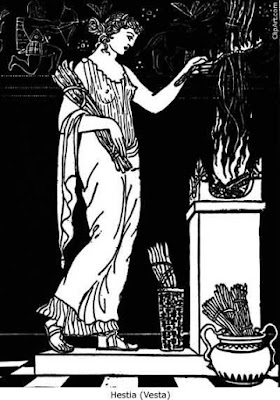
Ancients of pre-Christian Rome celebrated the festival of Lemuria on May 13th.  During this "Lemuria/Lemuralia", rites were performed to exorcise the lemures [restless malevolent spirits].  Priestesses of the Goddess Vesta [goddess of the hearth] would prepare offerings of beans and sacred flour cakes [made from the first ears of seasonal wheat].  [2]

Conversion Intentions by Catholic Popes

So what link connects Halloween to a Roman festival in spring and Celtic celebration in fall?   Enter:  The Catholic Church.

Around 609-610 Pope Boniface IV dedicated the Pantheon in Rome to the Virgin Mary and all Martyrs, converting it into a Christian Church and thusly establishing the feast of  dedicatio Sanctae Mariae ad Martyres. [3]

This is the first known instance in Rome of transformation of a Pagan temple into a site for Christian worship.  The date of this conversion, May 13th, is not likely to be coincidental and is believed to have occurred in attempt by the Catholic Church to de-Paganize Rome.

In the 8th century, Pope Gregory III founded an oratory for the relics "of the holy apostles and of all saints, martyrs and confessors, of all the just made perfect who are at rest throughout the world". 

Pope Gregory III added saints to the celebration of Boniface IV's martyrs, calling it All Saint's Day [or All Hallowmas from the Middle English for Alholowmesse].  [4]

Additionally, Pope Gregory III moved the date of the sacred feast from May 13th to November 1st in attempt to envelope the Celtic celebration of Samhain; hopeful for a smooth conversion of Ireland to Christianity.

Over time, Samhain celebrations merged with those enjoyed on the eve of All Saint's Day, called All Hallow's Eve and, eventually, 'Halloween' [first attested in the 16th century].  ( [5] The Oxford English Dictionary (2nd ed.). Oxford: Oxford Univ. Press. 1989. ISBN 0-19-861186-2.)    

We often hear from conservative Christians about the evil Pagan roots of our modern holiday and yet the irony proves hysterical when we consider that the day is celebrated today because of its connections to the Catholic Church and its intentions to convert the Romans, Celtics and Gaels by overshadowing local festivals with comparable observances of their own. 

Speaking of conservative Christians...

Recently a very slanderous and ignorant opinion article was posted in Business Week unleashing harsh and inaccurate depictions of Paganism's grips on an otherwise Christian-West [through the celebration of Halloween]. [6]

The author, Amity Schlaes, states "Halloween isn’t secular. It is pagan. There’s nothing else to call a set of ceremonies in which people utter magical phrases, flirt with the night and evoke the dead."  It wasn't long at all before Mrs. B of the popular blog Confessions of a Pagan Soccer Mom and other icons from the Witching World enlightened our research-deprived Mr. Schlaes with counterresponses containing references to the actual origins of America's Halloween.

Truth be told, Halloween and Samhain are two separate holidays, among many across the globe, which happen to fall on the same date during the year.

Mrs. B commented "Cultures, including those that follow Christian faiths, honor their ancestors this time of year all over the world. Why focus just on those people of Pagan faiths?  Seems a little like religious persecution to me. "

When will we see a time when supposed reputable sources for news, such as Business Week, demand more [ie, the truth] from authors submitting articles to their publications?  Let's leave the spewing of lies to the tabloids, shall we?!

Happy Halloween, Samhain, Day of the Dead, Ten Chieh, Yue Lan, Alla Helgans Dag & many many more!
Monday, October 10, 2011

Why Deny: Connections Between Christianity & Paganism

When I lost my faith as a young girl, it took many years of research into the generic realm of faith and religion to find my way to Paganism.  Because of this self-induced decade of study, I came to learn much about the history of different religions and the very similar, overlapping connections shared by many.  I've proposed these similarities in conversations of the past and find people are typically unwilling to accept that Christianity has much in common with ancient Pagan beliefs, rituals, symbols and more.

Why the denial?  Recognizing that your religion shares a past with another doesn't taint it or steal it from your heart anymore than the advances of science overshadow faith.  People still believe, regardless.

Reactions by Christians upon my suggestion that our religions have a shared background have always intrigued me -- from laughter to scoffs to outright anger.  Finally an article written by Ellen Lloyd, [author of Voices from Legendary Times], has shed some light on the topic.

In the article, Christianity Jesus and the Pagan Connection, Ellen explains that "a majority of us [Christians] associate Paganism with idol worship, blood sacrifices and witchcraft.  We [Christians] were taught to believe that Pagans are primitive people, who in some way worship the Devil."

Makes sense then that they would find issue with having their "pure, sacred and unique" religion of Christianity based, however loosely, on ancient occult beliefs and practices.  However, Ellen warns, "to write off something as 'impossible' is an easy and quick process... but before we [Christians] reject the Christian/Pagan connection, we should first ask ourselves a couple of questions."

In her article, Ellen's questions seek to answer if perhaps Christians have a wrong and very twisted image of old traditional Paganism.  "Were the mystery religions maybe more spiritually developed than we realize?  What was the true reason for painting followers of the mystery religions in such black colors?" she asks.

The author recognizes that the Church's past is tainted by its political and social struggle for power.  Long wars were waged by the Church of Rome and the Roman Empire to eradicate Paganism and its followers.  However, within their bloody intent to take over as the majority shareholder[s] of spirituality, these early enforcers for the Church brilliantly understood that by adopting  portions of Pagan dates, rites & rituals, their chances of conversion increased drastically. 

And by painting a dark and sinister portrait of the Old Ways, long-term success was all-but guaranteed.  Because even millenia later, who would think to question the Church -- especially considering the deterring examples made of those who did [insert horrific tales from the Crusades, the Inquisition, or the Burning Times].  People accepted out of fear. 

And then it was just a matter of permitting time to cover-up any true origins...  what was once clear embellishment turned to possible... and what was possible, after more time, turned to probable... to likely... to absolute.  Centuries after the life and death of Jesus Christ we find ourselves now struggling to convince His followers that much of what they irrefutably consider to be His tale was in-fact borrowed.  The plan worked wonders.

Yet if more Christians took an eye-opening glance into historical references and symbolism of the past -- a past, mind you, that precedes the life of their savior -- they may be shocked to find handfuls of identical stories and icons.  Author Ellen cites more than a few compelling examples including present-day traditions of the Christmas season, the birth story and life of Jesus  and other similar saviors and the existence of the cross at least 14 centuries before Jesus Christ.  [The Scandinavians, for example, considered it a representation of the four equinoxes and even celebrated a crucifixion of the sun upon its arrival at the shortest day.]

Even Bishop and self-proclaimed Christian Druid Alistair Bate, in his contribution to the book The Path of the Blue Raven [by Mark Townsend] stated "the Christian and pre-Christian myths are so intertwined,  interdependent and complementary as to be inseparable".

There is far more here than can be so easily dismissed with a laugh, scoff or angry outburst.  Just as much of our lands, our histories and even our genetics have intermingled since the dawn of man, so too have our religions.  Instead of taking offense, take interest!  There are some fascinating tales interlinking many different faiths and cultures.  What once created wars and rifts now has the potential to bring us together.

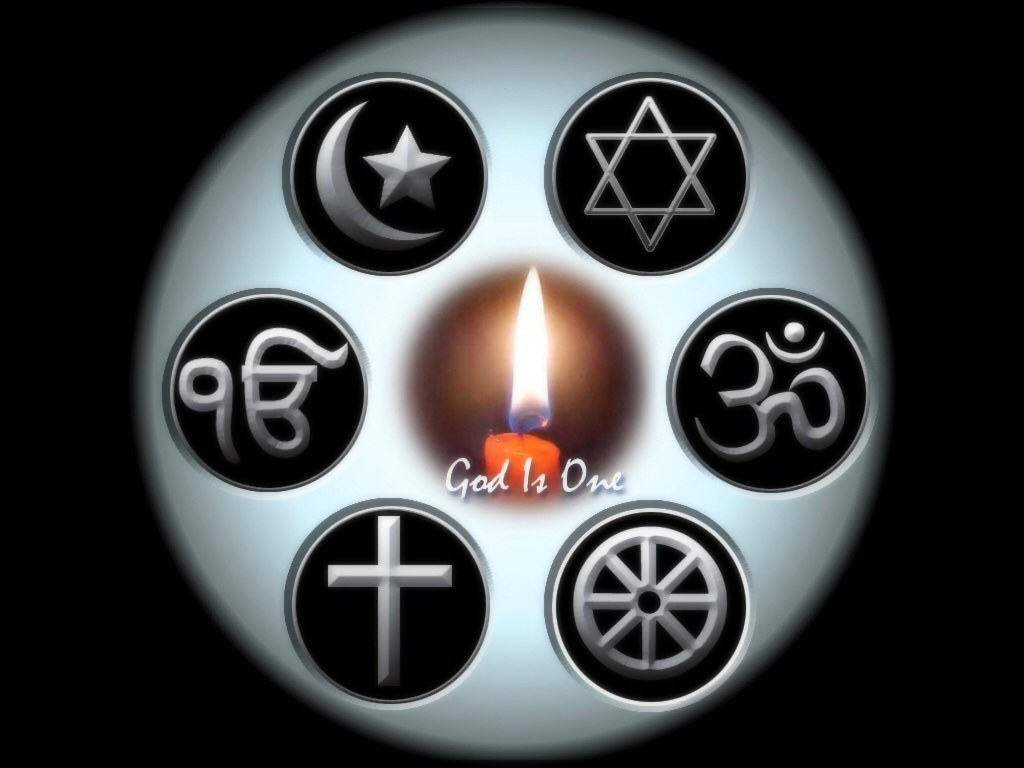
Divine Unity : Many paths up the same mountain.